
In modern industrial production, linear vibrating screens, with their advantages of large processing capacity, simple structure, and convenient maintenance, have become core equipment for material classification and screening in industries such as mining, metallurgy, coal, and chemicals. However, in actual operation, many production sites often encounter a thorny problem—uneven material discharge from the screen surface, even exhibiting biased flow.
This phenomenon not only directly reduces screening efficiency and causes impurities in the finished material, affecting downstream processes, but also causes potential damage to the equipment itself, such as excessive wear of the screen mesh and uneven load on the vibrating motor, ultimately shortening the service life of the vibrating screen. To help companies fundamentally solve this problem, this article will comprehensively analyze the underlying causes of uneven material discharge from linear vibrating screens and provide systematic and operable optimization solutions.
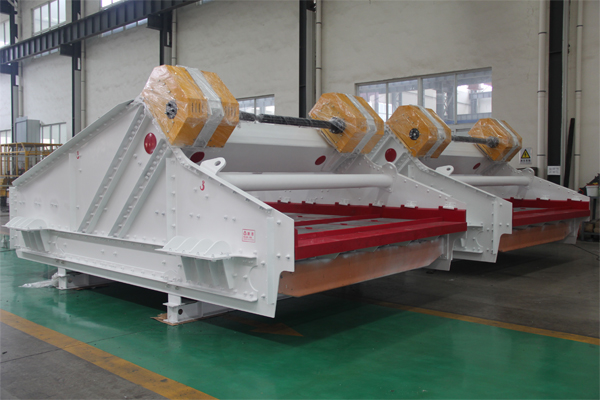
To solve the problem of uneven material discharge, it is essential to understand the working principle of linear vibrating screens. Linear screens typically use two identical vibrating motors rotating synchronously in opposite directions. The excitation forces generated by the eccentric blocks cancel each other out in the direction parallel to the motor shaft, but superimpose in the perpendicular direction, causing the screen body to reciprocate along a linear trajectory.
When the material on the screen surface no longer exhibits a uniform “linear jumping” motion, but instead shifts to one side or accumulates, it is usually due to the following four factors:
Feeding Stage Offset: The feeding stage is the first step for material to enter the screen. If the feeder is not installed in an accurate position or the material drop point of the belt conveyor is not aligned with the center of the screen surface, the material will shift laterally upon entering the screen. Initial velocity deviation and uneven accumulation of the center of gravity often directly lead to one-sided accumulation of material on the screen surface, resulting in uneven discharge.
Inconsistent Excitation Force Vectors: The core power of a linear screen comes from two vibrating motors. If there is a difference in the weight of the eccentric blocks, inaccurate angle adjustment, or motor aging causing power output deviation, the center of gravity of the screen box will experience uneven force, resulting in torsional swaying or non-ideal linear motion, further causing material deviation.
Equipment Foundation and Levelness Errors: Vibrating screens have extremely high requirements for the flatness of the installation foundation. After long-term operation, foundation settlement or inconsistent stiffness of the support springs can cause slight tilting of the screen box. Material, under gravity, accumulates at the lowest point, resulting in uneven discharge.
Structural Stiffness and Screen Tension Issues: If cracks appear at the welded joints of the screen box frame, or bolts loosen, local stiffness decreases, altering the vibration frequency and causing secondary vibrations. Uneven screen tension creates localized unevenness, causing material to accumulate in the “grooves,” ultimately leading to abnormal discharge distribution.
For the above four types of problems, enterprises can achieve precise calibration through layered troubleshooting and repair from external feeding to internal power.
1. Optimize the Feeding System, Control the “Source”
The distribution of material on the screen surface largely depends on its entry method.
Install a distributor: Install a funnel-shaped distributor or receiving hopper above the feed inlet. This physical buffer will evenly distribute the material, ensuring coverage of the entire screen width and reducing initial flow deviation.
Adjust the drop point: The guide liner needs precise adjustment to ensure the material falls vertically and aligns with the screen’s centerline, eliminating lateral initial velocity deviation.
...
For more detailed information on how to solve the problem of uneven material discharge from a linear vibrating screen, please click to visit: https://www.hsd-industry.com/news/how-to-fix-uneven-material-discharge-in-linear-vibrating-screens/