
Selecting the right crucible for high-temperature metal melting or alloy production at 1600°C is a critical decision that directly impacts process efficiency, product quality, and operational cost. While both graphite and clay crucibles are widely used, their performance diverges significantly under extreme thermal loads. This article provides a rigorous technical comparison, equipping engineers and procurement professionals with the data needed to choose the optimal material for applications requiring sustained 1600°C performance.
Graphite crucibles are manufactured from high-purity natural or synthetic graphite, often bonded with carbonaceous binders and fired at ultra-high temperatures. The resulting structure is highly crystalline, giving graphite exceptional thermal conductivity (typically 100–130 W/m·K) and low thermal expansion. These properties make graphite crucibles extremely resistant to thermal shock—a critical advantage when rapidly heating to 1600°C or cooling.
Clay crucibles, also known as ceramic or refractory crucibles, are made from aluminosilicate clays (such as fireclay) blended with grog (fired clay particles) to reduce shrinkage. Their microstructure is more amorphous and porous than graphite. Thermal conductivity is low (around 1–3 W/m·K), meaning clay crucibles heat more slowly but provide better insulation. However, their coefficient of thermal expansion is higher, making them more prone to cracking under rapid temperature changes.
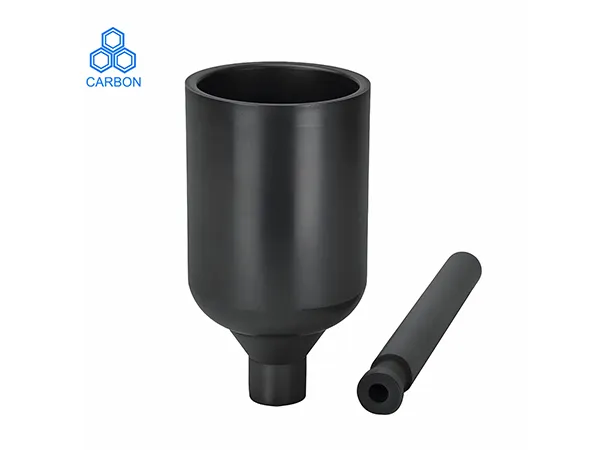
When operated continuously at 1600°C, the following factors determine crucible suitability.
...
For more information on whether graphite crucibles or clay crucibles perform better at 1600°C, please click to visit:https://www.czgraphite.com/a/news/graphite-vs-clay-crucible.html