
In cement manufacturing, consistent product quality is a non-negotiable requirement. Among the many process control tools, vibrating screens play an often-underestimated yet indispensable role in ensuring that raw materials, intermediate products, and final cement meet strict particle size specifications. A well-designed vibrating screen not only improves production efficiency but also directly impacts the uniformity of the finished product, reducing the risk of downstream defects. For plant managers and quality engineers exploring screening solutions, understanding how these machines contribute to quality control is the first step toward making an informed investment. This article examines the critical functions of vibrating screens in cement production, outlines the key parameters that influence screening performance, and presents the advantages of Haiside vibrating screens for achieving consistent quality outcomes.
Vibrating screens are mechanical devices that separate bulk materials by particle size through vibration-induced stratification and passage. In cement production, they are deployed at multiple stages: from raw material crushing (limestone, clay, gypsum) to clinker cooling and final product finishing. Their primary quality control contributions include:
Each of these applications demands a screen that can handle high throughput, resist blinding (clogging), and deliver precise cut points under dusty, abrasive conditions. Without effective screening, variability in particle size leads to inconsistent setting times, reduced strength, and increased customer complaints.
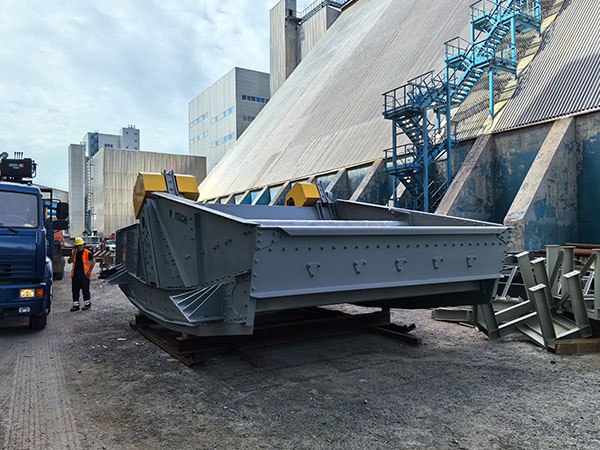
Not all vibrating screens are equally effective in cement quality control. Several design and operational parameters determine whether a screen can maintain the required separation accuracy over time:
The vibration pattern (linear, circular, or elliptical) and amplitude directly affect material movement and stratification. For cement applications, linear motion screens are often preferred because they provide uniform acceleration across the entire deck, reducing the risk of particle segregation. Adjustable amplitude allows operators to fine-tune the screen for different materials without changing the eccentric mass. Haiside vibrating screens feature a robust eccentric shaft drive system that delivers consistent vibration energy even under varying feed loads, ensuring stable cut points.
The type of screen deck – woven wire mesh, polyurethane panels, or rubber sheets – influences both durability and screening efficiency. In cement plants, wear and corrosion from moisture and fine particles accelerate media degradation. High‑tensile steel wire or polyurethane modular panels offer longer service life and resistance to blinding. Haiside offers a range of abrasion‑resistant screen media specifically engineered for cement environments, with open areas optimized to maximize throughput without compromising accuracy.
Blinding – when particles wedge into apertures or adhere to the screen surface – is a major cause of quality deviation. Vibrating screens for cement must incorporate features such as ball decks, ultrasonic vibrations, or trapezoidal wire to keep apertures clear. Haiside integrates an advanced self‑cleaning system that utilizes adjustable ball tray support to reduce blinding by up to 40% compared to conventional designs, maintaining consistent screening efficiency even with high‑moisture materials.
...
For more detailed information on the role of vibrating screens in cement production quality control, please click to visit: https://www.hsd-industry.com/news/the-role-of-vibrating-screens-in-cement-production-quality-control/