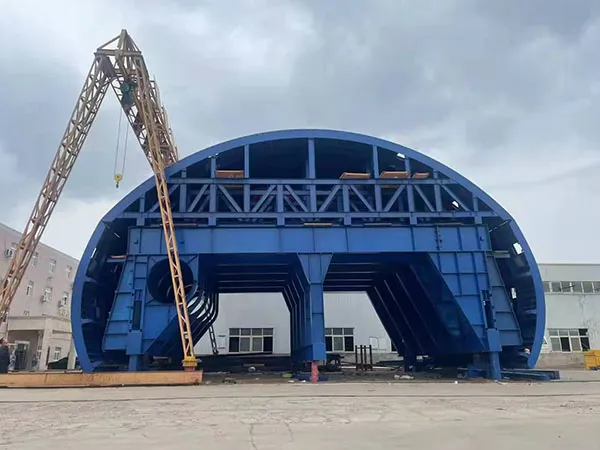
Selecting the right tunnel formwork system is a critical decision that directly impacts project timelines, budget, and final quality. For civil engineering professionals evaluating forming solutions, the choice between one-piece (full-section) and segmental (incremental) tunnel formwork is often the first crossroads. Each system offers distinct advantages depending on tunnel length, cross-section geometry, site logistics, and production volume. This article provides a technical, unbiased comparison of the pros and cons of both methods, drawing on Gaofei's extensive experience in delivering customized formwork solutions for tunneling projects worldwide. By understanding these differences, you can make an informed decision that balances speed, cost, and structural integrity.
Understanding the Core Differences Between One-Piece and Segmental Tunnel Formwork
Structural Design and Assembly
One-piece tunnel formwork consists of a single, rigid steel or aluminum form that matches the entire cross-section of the tunnel. It is typically assembled on-site and moved as a monolithic unit using hydraulic or mechanical systems. In contrast, segmental tunnel formwork divides the cross-section into multiple segments — often a base slab, two side walls, and a top arch — that are installed sequentially. Segments are lighter and easier to handle individually but require more joint connections and alignment adjustments.
Application Scenarios
One-piece systems are ideal for short to medium tunnels with consistent cross-sections, such as subway stations, pedestrian underpasses, or small road tunnels. Segmental formwork excels in long tunnels, variable geometries, or projects with tight access constraints, where transporting a full-section form would be impractical. Gaofei's engineering team often recommends segmental systems for large-diameter tunnels or those requiring multiple curves and tapers.
Key Advantages of One-Piece Tunnel Formwork
-
Faster cycle times: A single form can be stripped, moved, and reset in one operation, reducing labor and crane time. Typical cycle times for one-piece systems are 1–2 days per pour.
-
Superior concrete finish: Fewer joints mean less grouting and surface repair. The monolithic pour eliminates cold joints and alignment mismatches.
-
High dimensional accuracy: The rigid structure maintains strict tolerances, critical for tunnels with waterproofing membranes or precast lining integration.
-
Lower initial labor cost: Fewer components simplify assembly and require less skilled labor compared to segmental systems with multiple connection points.
-
Ideal for repetitive short runs: When the tunnel length is limited (e.g., 50–200 meters), the transport and handling challenges of a large form are manageable.
Key Advantages of Segmental Tunnel Formwork
-
Flexibility in geometry: Segments can be adjusted independently to accommodate varying cross-sections, curves, or tapers without building a completely new form.
-
Easier logistics and transport: Each segment fits standard shipping containers or trucks, reducing shipping costs and allowing use in remote or urban sites with limited crane capacity.
-
Reduced storage footprint: Segments can be stored on-site in a smaller area and assembled incrementally as the tunnel progresses.
-
Lower initial investment: Building a segmental form typically requires less steel and simpler fabrication, making it cost-effective for projects with uncertain or phased schedules.
-
Simpler maintenance and repairs: Damaged segments can be replaced individually without dismantling the entire system.
-
Adaptable to long tunnels: For tunnels exceeding 500 meters, segmental systems allow continuous casting while the form moves along the tunnel, avoiding the need to reposition a massive single piece.
For more detailed information on the pros and cons of monolithic versus segmental tunnel formwork, please click here: https://www.gf-bridge-tunnel.com/a/blog/tunnel-formwork-pros-cons.html