
Specifying tunnel formwork for high-strength concrete demands a rigorous approach that goes beyond standard formwork selection. High-strength concrete—typically defined as concrete with compressive strength above 60 MPa—exhibits lower workability, higher density, and greater autogenous shrinkage, which impose unique stresses on formwork systems. The formwork must not only withstand higher hydrostatic pressures but also maintain strict dimensional tolerances and surface finish quality. For engineers and contractors, the specification process requires careful evaluation of load capacity, stiffness, joint tightness, and release agent compatibility. This article provides a structured guide to specifying tunnel formwork specifically for high-strength concrete, drawing on Gaofei's long-standing experience in delivering robust formwork solutions for demanding infrastructure projects.
High-strength concrete behaves differently from conventional concrete during placement and curing. Its lower water-cement ratio results in higher viscosity and greater lateral pressure against formwork—especially during initial setting. Additionally, the reduced bleeding means less self-lubrication between concrete and form panels, increasing the risk of surface defects. These characteristics directly affect formwork specification:
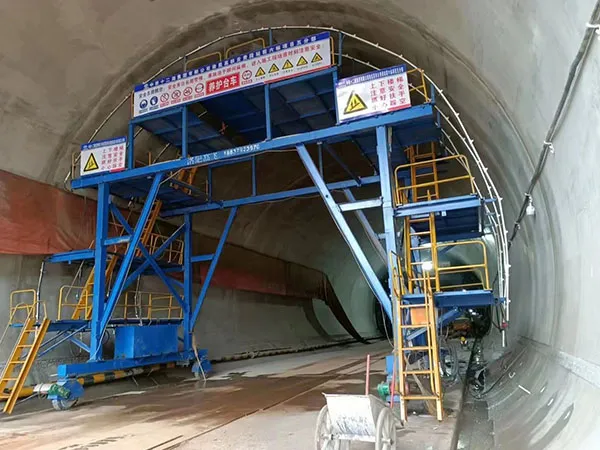
When drafting a technical specification for tunnel formwork intended for high-strength concrete, the following parameters must be clearly defined:
The formwork must be rated to withstand the full lateral pressure of high-strength concrete without excessive deflection. Specify minimum design loads based on concrete density (typically 2500 kg/m³) and pour rate (up to 2 m per hour). Minimum stiffness: deflection limited to L/400 or 3 mm, whichever is stricter. For tunnel formwork, consider both internal and external loads—including equipment, crew, and wind if applicable.
High-strength concrete requires form panels with very low porosity to prevent water absorption and staining. Recommend steel-faced panels (thickness ≥ 4 mm) or high-density overlaid plywood with sealed edges. Specify surface roughness (Ra ≤ 6.3 μm for visible concrete). Ensure all joints are flush, with no gaps exceeding 0.5 mm.
Leakage at form joints causes sand runs and aggregate exposure—unacceptable for high-strength concrete. Require continuous gaskets at all panel connections and a positive locking mechanism. Provide a maximum grout leakage allowance of 0.1 L per linear meter of joint per hour under full hydrostatic pressure.
High-strength concrete demands release agents that do not react with cement or leave residues that compromise bond-to-reinforcement. Specify oil-based or water-based release agents with proven performance on identical concrete mixes. Ban the use of diesel or low-quality oils that can cause discoloration.
...
For more details on how to specify tunnel formwork for high-strength concrete, please click here: https://www.gf-bridge-tunnel.com/a/blog/how-to-specify-tunnel-formwork-for-high-strength-concrete.html