
In semiconductor wafer handling robots, every motion must be executed with sub-micron precision under extremely demanding cleanroom and vacuum conditions. The bearing system directly determines the robot's positioning accuracy, stiffness, and long-term reliability. Crossed roller bearings have emerged as the preferred choice for these applications due to their unique combination of high load capacity, compact cross-section, and exceptional rotational accuracy. This article examines why crossed roller bearings outperform conventional bearing types in wafer handling robots, and how selecting the right bearing partner—such as PRS—can optimize your robot's performance and lifespan.
Semiconductor wafer handling involves rapid pick-and-place cycles, minimal vibration, and strict cleanliness standards. Crossed roller bearings meet these challenges through their distinctive design: cylindrical rollers arranged at 90° alternating orientation between inner and outer rings. This configuration provides several critical advantages.
Unlike ball bearings, which rely on point contact, crossed roller bearings use line contact between rollers and raceways. This results in significantly higher stiffness—typically 3 to 5 times greater than equivalent-sized ball bearings—for the same envelope. In a wafer handling robot, higher rigidity translates directly to reduced deflection under load, enabling faster accelerations without overshoot. The compact cross-section (often less than half the width of a comparable angular contact bearing pair) also frees up valuable space for other robot components, such as vacuum lines or sensors.
Crossed roller bearings achieve rotational runout accuracy of 2–5 μm for standard grades, with some precision grades reaching sub-micron levels. The alternating roller arrangement cancels out radial and axial play simultaneously, providing pure rotational motion without parasitic tilting. This is critical for wafer alignment stages and end-effector joints where even micron-level wobble can cause misalignment. Additionally, the low friction torque (<0.1 N·m for small sizes) ensures smooth start-stop motions, reducing particle generation from stick-slip effects.
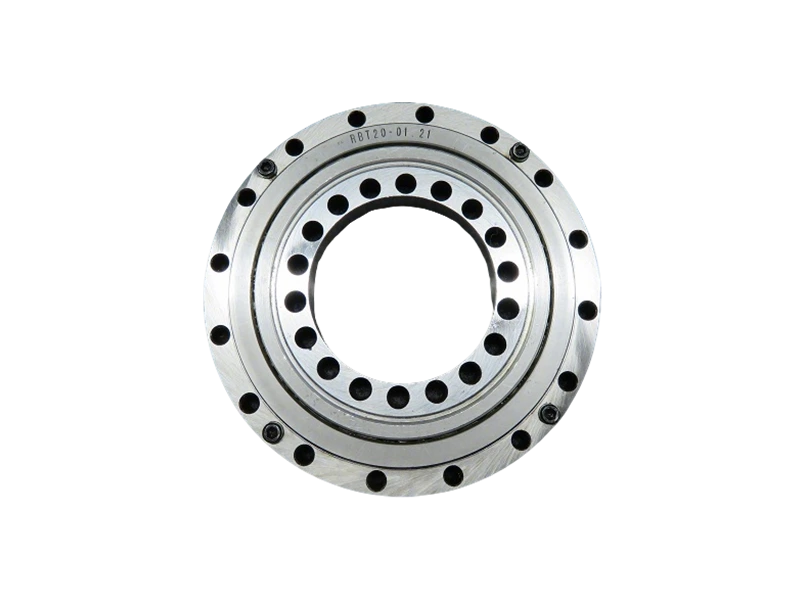
To understand the value proposition, engineers often compare crossed roller bearings against deep groove ball bearings, angular contact ball bearings, and needle roller bearings. The table below summarizes key differentiators for wafer handling applications.
For wafer handling robots, the superior rigidity and compactness of crossed roller bearings often justify their higher unit cost, especially when total cost of ownership includes reduced downtime and higher throughput.
...
For more detailed information on crossed roller bearings used in semiconductor wafer handling robots, please click to visit: https://www.prsbearings.com/a/news/crossed-roller_5ff21.html