
Optical instruments—from telescopes and microscopes to laser trackers and coordinate measuring machines—demand mechanical components that introduce no measurable error. Even a few microns of play or angular deviation can degrade image quality or measurement repeatability. Thin-section bearings have emerged as a critical enabler of the sub-arcminute accuracies these systems require. By understanding how their unique geometry reduces friction, minimizes deflection, and maintains consistent preload, engineers can specify bearings that directly improve instrument performance. This article examines the mechanisms by which thin-section bearings enhance accuracy and explains why they are increasingly the preferred choice for precision optical applications.
Unlike standard bearings that maintain a roughly square cross-section relative to bore diameter, thin-section bearings have a radially compact profile—typically with a cross-section height that is a fraction of the bore diameter. This design yields two fundamental advantages for optical instruments: reduced moment of inertia and lower rotating mass. With less mass to accelerate and decelerate, the bearing responds more quickly to position commands and settles with fewer residual vibrations. Additionally, the compact cross-section allows the bearing to fit within tight radial envelopes, enabling design engineers to locate the bearing closer to the instrument’s center of rotation, thereby minimizing lever-arm-induced errors.
Thin-section bearings from manufacturers like BIBO Bearing are typically manufactured from high-carbon chromium steel (e.g., AISI 52100) or stainless steel (440C) to achieve high hardness and dimensional stability. The raceways are ground and honed to tolerances in the single-digit micron range, and the balls are graded to Grade 5 or finer per ABEC/ISO standards. These precision grades ensure that radial runout and axial runout remain below 2–3 µm, a critical threshold for optical systems that must resolve features at the nanometer scale.
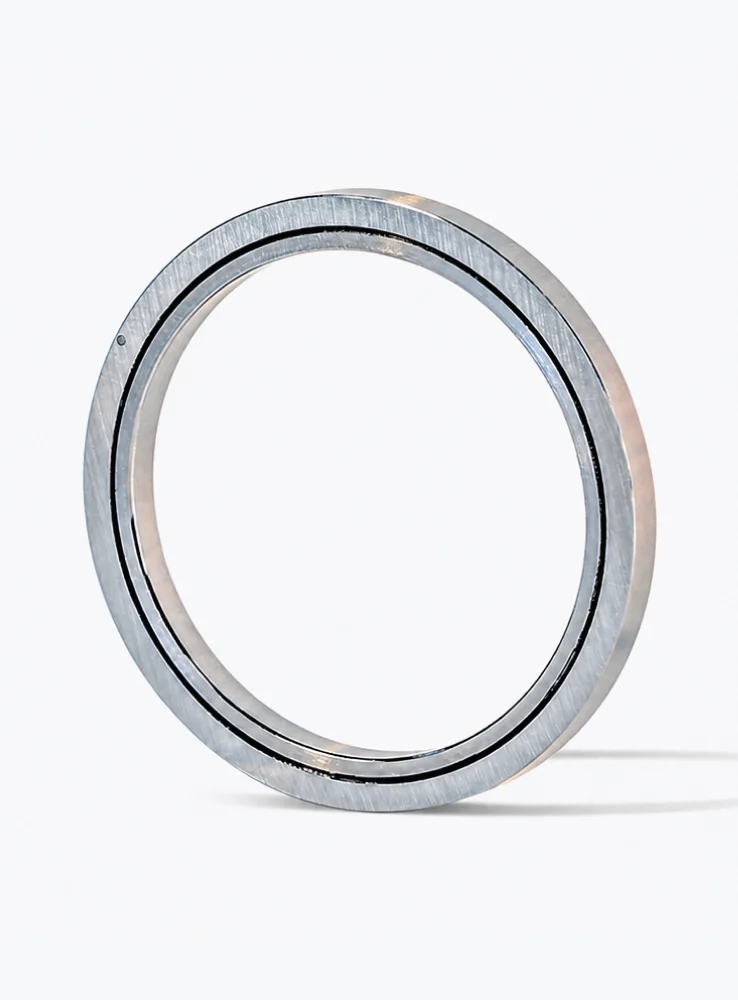
Accuracy in optical instruments is a function of both static alignment and dynamic stability. Thin-section bearings contribute on both fronts.
Optical positioning stages often require motion in the sub-micrometer range. Standard bearings with higher friction can exhibit stick-slip behavior, where static friction must be overcome before motion begins, leading to position overshoot and hysteresis. Thin-section bearings, because they use fewer and smaller balls (or rollers) under lighter preload, exhibit significantly lower starting torque and running torque. This allows smoother initiation and cessation of motion, enabling the servo controller to achieve finer positioning resolution. The result is consistent, repeatable positioning accuracy to within 0.5 µm or better in many commercial optical stages.
...
For more detailed information on how thin-section bearings can improve the accuracy of optical instruments, please click to visit: https://www.bobibearing.com/a/bearing-knowledge/thin-section-bearings-accuracy.html