
Achieving sub-arc-second accuracy in rotational motion is the defining challenge for engineers designing the next generation of precision equipment—from wafer handling robots to goniometric stages used in synchrotron beamlines. Traditional bearing technologies often fall short due to inherent clearance, compliance, or kinematic errors. Crossed roller bearings have emerged as the mechanical foundation that makes sub-arc-second positioning not just possible, but repeatable and reliable. This article examines the engineering principles behind this performance, compares crossed roller bearings with other precision bearing types, and illustrates how PRS’s design expertise helps customers reach the 0.1 arc-second threshold in real-world applications.
Sub-arc-second accuracy refers to angular positioning errors smaller than one arc-second (1/3600 of a degree). For a rotary table with a 200 mm diameter, a 0.5 arc-second error corresponds to a linear displacement of roughly 0.5 μm at the circumference. Achieving this level demands bearings with absolute minimum runout, friction variation, and elastic deformation.
Ball bearings rely on point contact, which leads to high Hertzian stresses and noticeable elastic deformation under load. Even preloaded angular contact ball bearings exhibit variations in contact angle and cage instability that produce periodic errors in the sub-arc-second range. Crossed roller bearings, by contrast, use line contact between cylindrical rollers arranged alternately at 90° angles. This geometry provides high stiffness in all radial, axial, and moment loading directions with minimal deflection—a prerequisite for sub-arc-second stability.
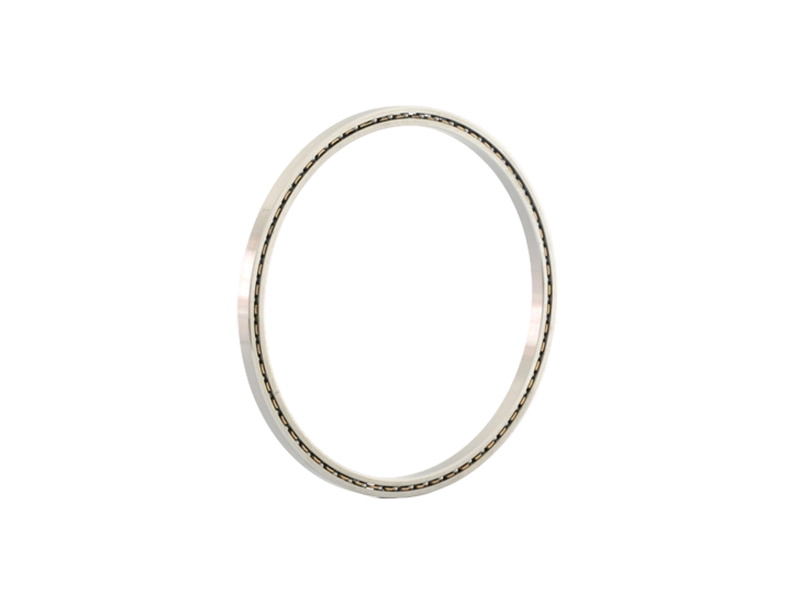
The key design feature of a crossed roller bearing is its roller arrangement: each roller is rotated 90° relative to its neighbor, with a separator (cage) maintaining precise spacing. This orthogonal orientation allows the bearing to absorb combined loads and constrain all degrees of freedom except rotation. When combined with precision-ground raceways and optimized preload, the result is a bearing with virtually zero clearance and highly uniform rolling resistance.
...
For more information on achieving sub-arcsecond accuracy using crossed roller bearings, please click to visit:https://www.prsbearings.com/a/news/sub-arc-second-accur.html