
In precision machinery and robotics, every millimeter of excess material can translate into design compromises—larger housings, heavier assemblies, or reduced dynamic response. Engineers repeatedly face the challenge of preserving load capacity, stiffness, and rotational accuracy while shrinking the overall footprint of rotating components. Thin-section bearings directly address this tension by offering a cross-section that is dramatically slimmer than standard bearing series without compromising core performance metrics. This article examines how thin-section bearings achieve this balance, compares them with conventional alternatives, and provides actionable guidance for selecting the optimal solution for space-constrained applications—with insights drawn from BIBO Bearing’s extensive engineering experience.
Thin-section bearings are radial ball bearings designed with a relatively small cross-sectional height relative to the bore diameter. While a standard deep-groove ball bearing of, say, 50 mm bore might have a cross-section of 10 mm or more, a thin-section bearing of the same bore can have a cross-section as low as 4 mm. This drastic reduction in material is achieved through optimized raceway geometries, specialized heat treatments, and tight control of internal clearance.
Industry standards such as ISO 281 and ABEC classes apply, but the defining feature is the bearing’s cross-sectional width (B) and height (H) being a small fraction of the bore diameter (d). Common thin-section series include the 16000, 6800, 6900, and the extra-thin 6700 series, as well as metric and inch-sized variants. BIBO Bearing offers these series with a range of cage materials—pressed steel, machined brass, and polyamide—to suit speed, temperature, and noise requirements.
To maintain performance despite the reduced raceway volume, thin-section bearings employ:
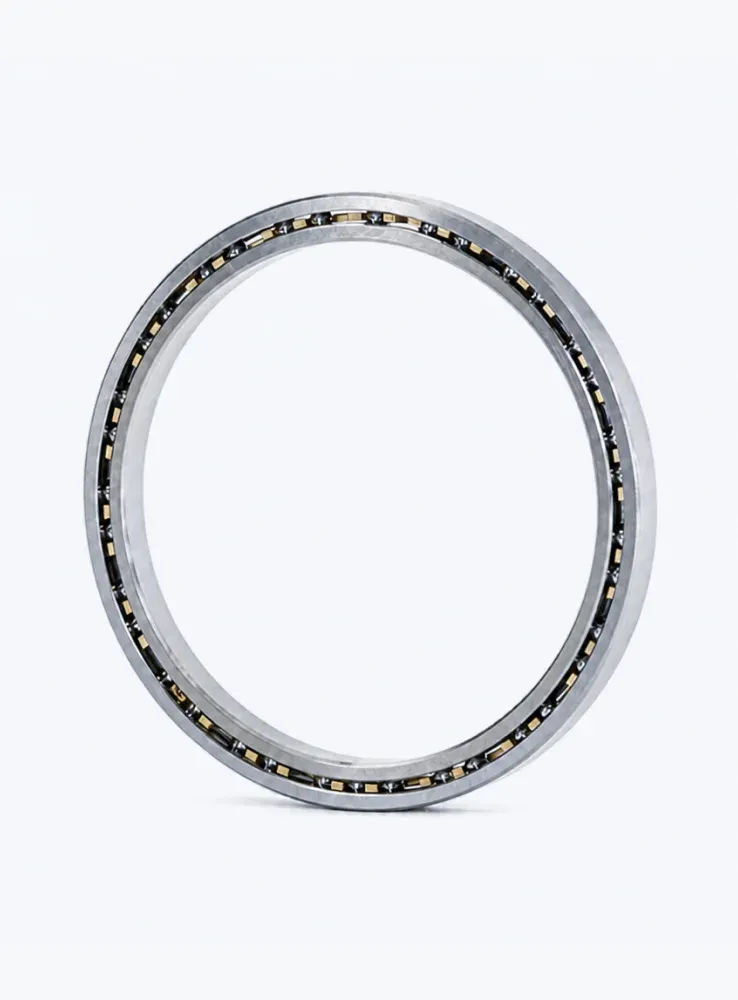
When design engineers compare thin-section bearings to standard bearings, the advantages become clear. The table below summarizes the key differentiators:
...
For more detailed information on maximizing space utilization without sacrificing performance using thin-section bearings, please click to visit: https://www.bobibearing.com/a/bearing-knowledge/thin-section-bearing-performance-guide.html