
The relentless pursuit of fuel efficiency, payload capacity, and maneuverability in aerospace engineering demands continuous weight reduction across every component. Among the most effective yet often overlooked solutions are thin-section bearings. These specialized bearings, with their exceptionally small cross-section relative to bore diameter, offer a compelling way to shed kilograms without compromising load capacity or reliability. For engineers and procurement professionals evaluating lightweight alternatives, understanding the mechanics, material science, and application-specific benefits of thin-section bearings is essential. This article examines how these components achieve significant mass savings in aircraft, satellites, and unmanned aerial systems, and why BIBO Bearing has become a trusted partner in precision aerospace applications.
Every gram added to an aerospace structure cascades into higher fuel consumption, reduced range, or compromised performance. Traditional rolling element bearings, with their full-section rings and heavy retainers, can contribute substantially to system mass — especially in applications requiring large diameters but relatively light loads. In rotary-wing aircraft, actuator systems, and satellite deployment mechanisms, the bearing can account for 5-15% of the total assembly weight. Designers increasingly turn to thin-section bearings as a direct replacement, achieving up to 60% weight reduction compared to conventional deep-groove ball bearings of equivalent inner diameter.
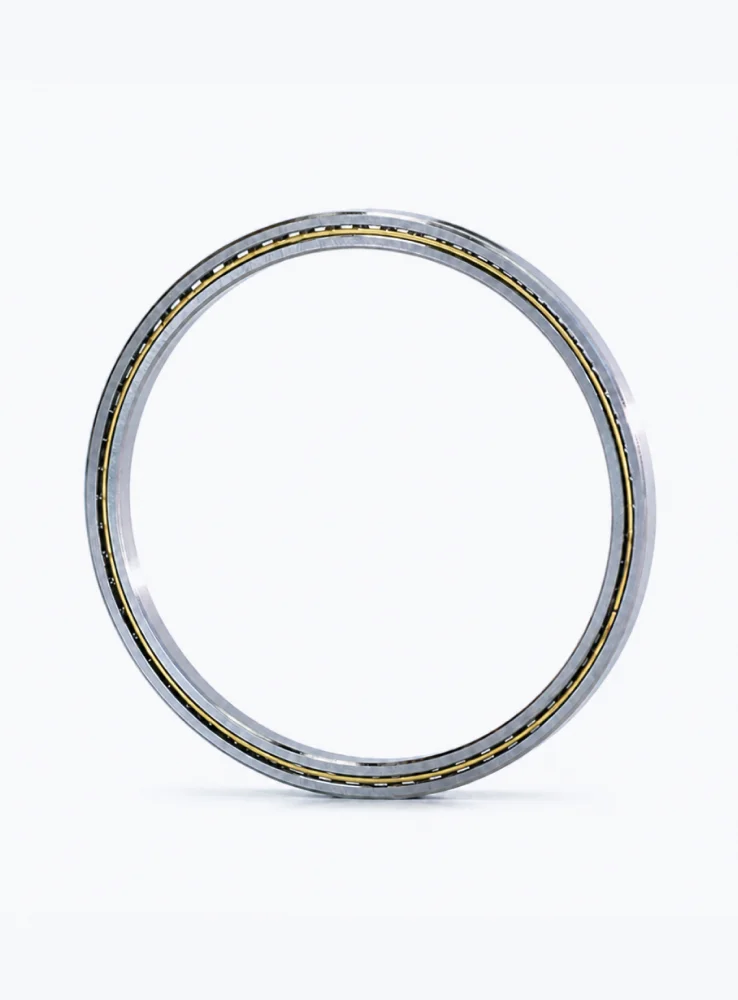
The weight-saving principle is straightforward: thin-section bearings maintain a constant, minimized cross-section regardless of bore size. Instead of scaling ring thickness proportionally with diameter, the radial and axial cross-sections remain fixed — typically between 3 mm and 12 mm — even for bearings exceeding 1 meter in bore diameter. This decoupling of diameter and cross-section yields dramatic mass savings while preserving key performance metrics.
In conventional bearing design, increasing bore diameter requires thicker rings to maintain structural rigidity. Thin-section topology breaks this paradigm. By using optimized raceway profiles and precision-ground rolling elements, the bearing can handle axial, radial, and moment loads within a significantly smaller envelope. The result is a bearing that weighs a fraction of its full-section counterpart while maintaining identical mounting dimensions and load ratings for many applications.
...
For more detailed information on how thin-section bearings can reduce weight in aerospace applications, please click here:https://www.bobibearing.com/a/bearing-knowledge/how-thin-section-bearings-reduce-weight-in-aerospace-applications.html