
Comminution is the largest single consumer of electrical energy in most mineral processing plants, and in hard-rock operations it can account for the majority of the site's power draw. Every kilowatt-hour removed from the grinding circuit therefore flows straight to the bottom line. High-pressure grinding rolls, commonly known as HPGR, have become one of the most credible ways to achieve that reduction, not because they grind more aggressively, but because they break ore in a fundamentally different way. This article explains the mechanism behind HPGR power savings, identifies exactly where the energy gains originate, and sets out the design and operating factors that determine whether those savings are realised in practice rather than simply promised on a datasheet.
Tumbling mills, whether autogenous, semi-autogenous or ball mills, break rock through a combination of impact and abrasion inside a rotating shell. The problem is one of energy transfer efficiency. A significant share of the electrical energy delivered to the mill motor is dissipated as heat, noise, vibration and steel media wear rather than as new fracture surface. Lifting the charge, rotating the shell and the mill's own drivetrain all absorb power before any rock is broken at all.
Two further inefficiencies compound the problem. First, tumbling mills tend to over-grind a portion of the feed while under-grinding the coarsest particles, because residence time is distributed unevenly. Second, liberation is achieved by grinding everything finer than necessary, which consumes energy on material that is already sufficiently liberated. The core inefficiency of conventional grinding is that energy is applied to a random charge rather than directly to the particles that need breaking.
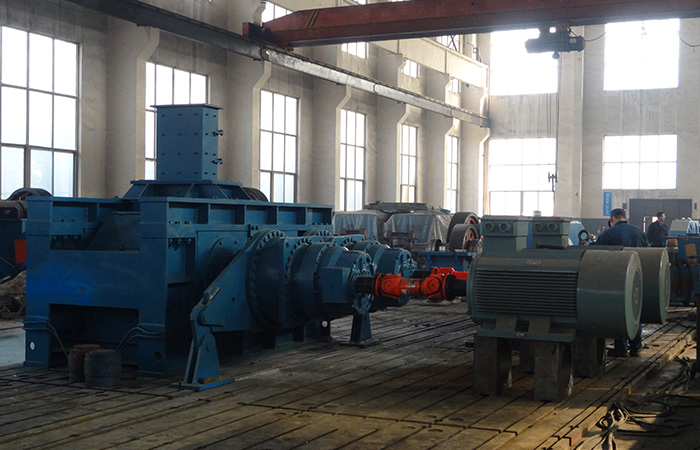
HPGR operates on a principle known as inter-particle, or bed, comminution. Material is fed between two counter-rotating rolls, one of which is fixed while the other is held under hydraulic pressure. The gap is deliberately choked with material, so particles are compressed against one another rather than crushed between two steel surfaces.
As the feed enters the compression zone, roll pressure builds to several tens of megapascals and the particle bed is compacted into a dense cake, often called a flake or scurf. Individual particles are loaded from multiple directions by their neighbours. Because the load is distributed across the whole bed, breakage occurs throughout the material rather than only at the surfaces of the rolls, and the energy is applied to the ore instead of to grinding media.
The most commercially valuable outcome of HPGR is not the immediate size reduction but the damage left behind. Compression along grain boundaries generates a network of micro-cracks through each particle. The discharge cake looks coarse, yet the particles are structurally weakened. When that material reports to a downstream ball mill or stirred mill, it fractures far more easily, which reduces the specific energy required in the following stage. This is the mechanism by which HPGR savings extend well beyond the rolls themselves.
It is worth being precise about the sources of savings, because they are often presented as a single headline figure. In reality the gain is the sum of several distinct effects:
...
For more details on how high-pressure grinding rolls (HPGR) can save electricity, please click here: https://www.zymining.com/en/a/news/hpgr-power-savings.html