
In modern robotics, joint precision is the cornerstone of repeatable motion, load handling, and overall system reliability. As robots are deployed in high-stakes environments such as medical surgery, semiconductor manufacturing, and collaborative assembly, even micron-level errors can lead to costly defects or safety risks. Crossed roller bearings have emerged as a critical enabler of this precision, offering a unique combination of rigidity, low friction, and multi-axis load support. This article explores the technical principles behind crossed roller bearings, how they directly improve robot joint performance, and why PRS has become a trusted partner for engineers seeking maximum accuracy and durability.
Unlike conventional ball bearings that rely on point contact, crossed roller bearings use cylindrical rollers arranged in a crossed pattern between inner and outer rings. Each roller acts like a miniature beam, distributing loads over a line of contact rather than a single point. This design allows the bearing to simultaneously handle radial, axial, and moment loads with minimal elastic deformation. The rollers are typically separated by a cage or spacer to prevent friction between adjacent rollers, ensuring smooth and consistent motion even under high preload.
The most significant feature of crossed roller bearings is the 90-degree roller orientation. This configuration creates a highly rigid structure that resists tilting and twisting forces. Additionally, the absence of a conventional ball raceway eliminates the “ball spin” phenomenon, which causes uneven wear and position loss over time. The result is a bearing that maintains its original accuracy throughout its service life, a critical requirement for robotics applications where recalibration is costly or impractical.
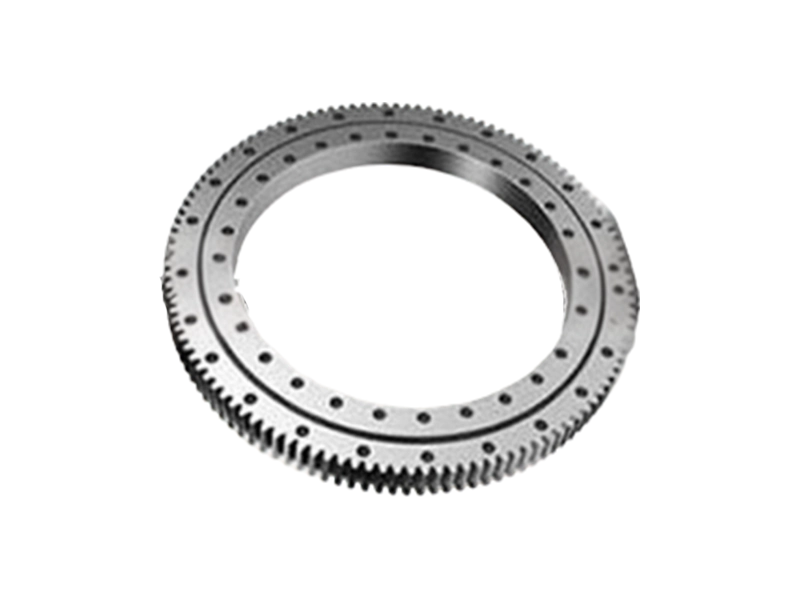
Robot joints are subjected to complex, multi-directional loads: gravitational forces from the arm, inertial forces from acceleration, and external forces from tool contact. A bearing that deflects even a few microns under these loads will cause cumulative positioning errors, especially in articulated arms with multiple joints. Crossed roller bearings provide nearly zero radial and axial runout, typically maintaining tolerance classes within 2–5 µm. This translates directly to higher repeatability—the ability to return to a programmed position with extreme consistency—and stiffness, which prevents oscillation or overshoot during high-speed motion.
...
For more detailed information on how crossed roller bearings can improve robot joint precision, please click to visit:https://www.prsbearings.com/a/news/how-crossed-roller-bearings-boost-robot-joint-precision.html