
In modern industrial systems where precision, compact design, and high efficiency are essential, thin section bearings have become a critical component across a wide range of applications. From industrial robotics and semiconductor equipment to aerospace assemblies and medical devices, these bearings support smooth motion while maintaining strict dimensional constraints.
However, many equipment failures do not originate from design flaws, but from inadequate maintenance practices. Among these, improper cleaning and lubrication remain one of the most common causes of premature bearing failure. This guide provides a comprehensive, practical, and experience-driven approach to cleaning and re-greasing thin section bearings, helping maintenance teams extend service life, reduce downtime, and improve overall equipment performance.
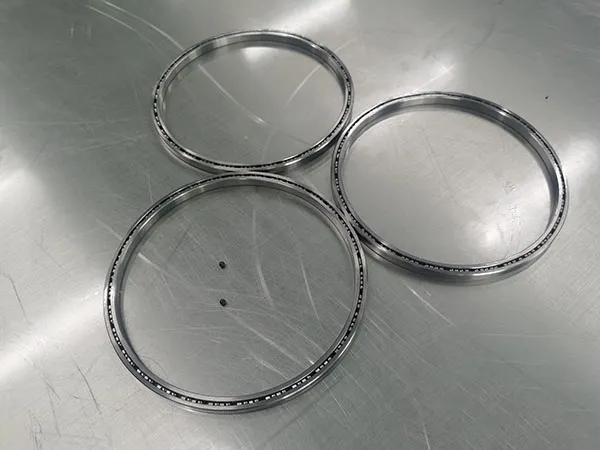
Thin section bearings are specifically engineered to deliver high load capacity within a minimal cross-sectional profile. Unlike conventional bearings, their thin-walled structure allows engineers to reduce overall system weight and size without compromising rotational accuracy.
Manufacturers typically use these bearings in applications such as:
Precision rotary tables
Industrial robot joints
Aerospace positioning systems
Automated inspection equipment
Medical imaging devices
While this compact design offers clear advantages, it also introduces certain vulnerabilities. The reduced cross-section makes these bearings more sensitive to contamination, lubrication degradation, and installation errors. Even small particles or insufficient lubrication can quickly affect performance, leading to increased torque, vibration, and wear.
Why Proper Cleaning and Re-Greasing Is Critical
...
For more detailed information on cleaning and relubricating guidelines for thin-section bearings, please click here: https://www.lynicebearings.com/a/blog/guide-to-cleaning-and-re-greasing-thin-section-bearings.html