
Processing heavy glass sheets — typically those exceeding 12 mm in thickness — places extraordinary demands on cutting table engineering. Conventional roller or felt-lined supports risk surface damage, edge chipping, and dimensional deviation under concentrated load. Air-float cutting tables solve these problems by lifting the sheet on a thin, uniform film of pressurized air, eliminating direct contact and enabling smooth positioning along the cutting axis. However, achieving reliable floatation and cutting accuracy with heavy formats requires a fundamentally different level of design rigor. This article examines the key optimization parameters, from plenum geometry to pressure control, and explains how DISAI engineers these systems for demanding production environments.
A standard air-float table designed for thinner glass maintains a modest air gap with relatively low plenum pressure. When the same table is loaded with a 19 mm jumbo sheet weighing well over half a ton, the outcome changes dramatically. The air film becomes uneven, portions of the sheet settle onto the table surface, and the resulting friction makes precise scoring strokes virtually impossible. Even a small reduction in the air gap cannot be tolerated in heavy-sheet work, because contact pressure rises non-linearly as the gap closes.
Compounding the issue is structural deflection of the table frame itself. Under heavy load, a lightly reinforced table may bow enough to create high and low zones across the cutting area. The air film cannot compensate for a non-flat support surface. For this reason, heavy-sheet optimization must address the pneumatic system and the mechanical substructure simultaneously.
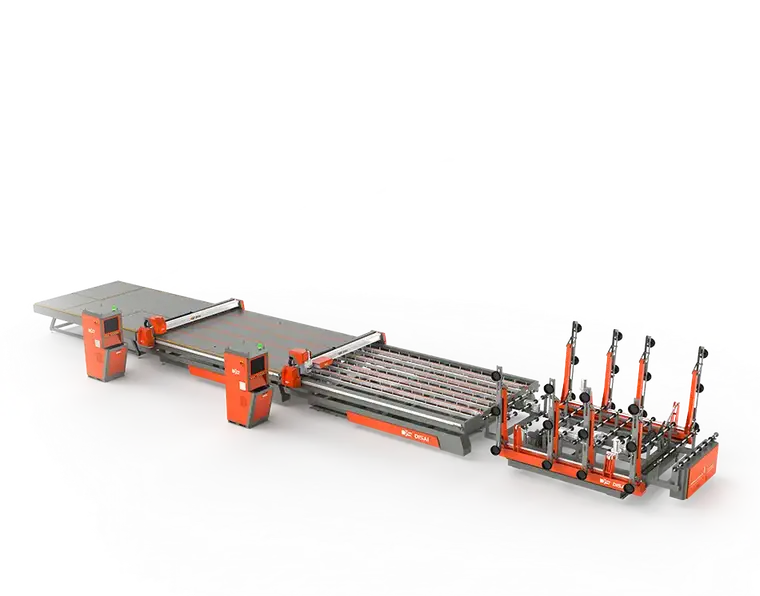
Optimization is not a single adjustment but a coordinated set of engineering decisions. The following parameters determine whether a table can handle heavy glass while maintaining cutting accuracy at production speed.
The plenum — the sealed chamber beneath the table top — must deliver equal pressure to every nozzle across the working area. In a heavy-sheet table, air consumption is considerably higher because more mass must be supported per unit area. If the plenum is too shallow or the inlet ports are undersized, pressure differentials develop between the center and the perimeter, causing the sheet to hover unevenly.
...
For more details on optimizing float glass cutting tables used for cutting thick glass sheets, please click here: https://www.disaiglass.com/industry-news/air-float-optimize/